Continuous Shuffle Machines Reshape True Count Thresholds for Insurance and Surrender Decisions
David Schmid · Sep 25, 2026
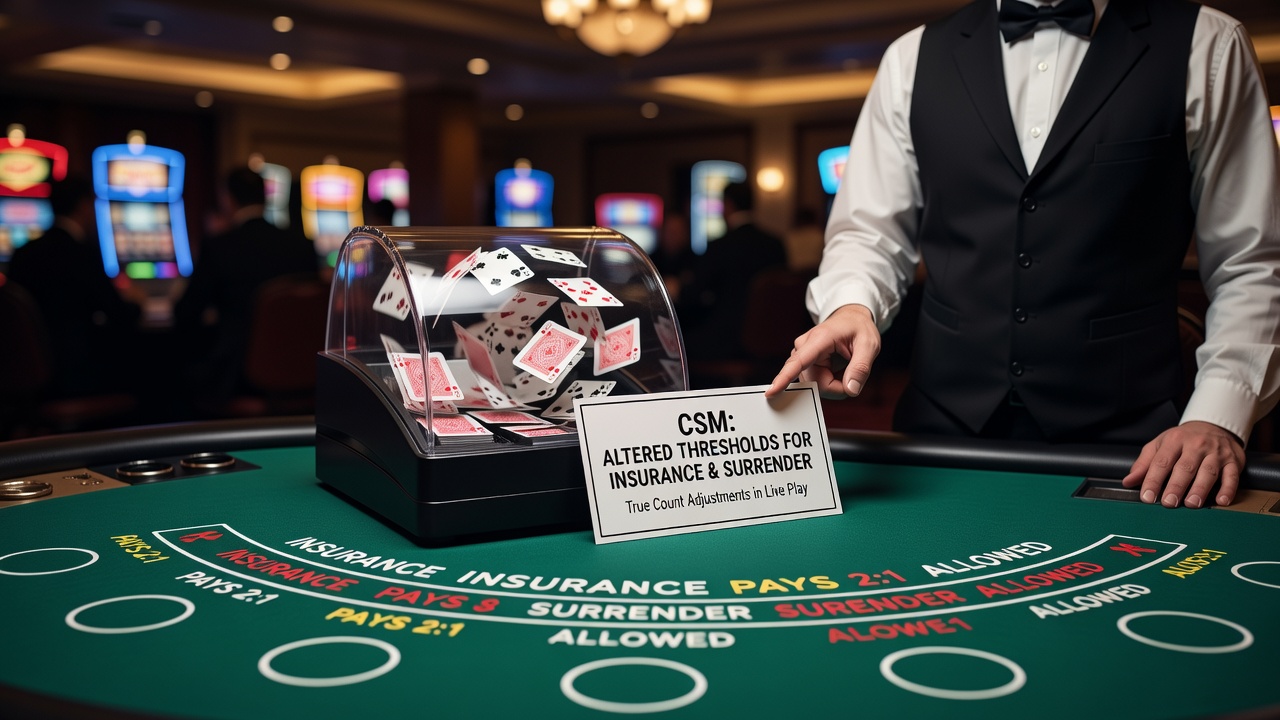
Continuous Shuffle Machines Reshape True Count Thresholds for Insurance and Surrender Decisions
Continuous shuffle machines operate by constantly mixing discarded cards back into the active deck, which creates a different environment for card counting compared with traditional shoe games. Researchers who examined these devices found that the ongoing randomization reduces the impact of removed cards on the remaining composition. This shift directly influences the true count levels at which players consider insurance bets and surrender options during live play.
Data from multiple casino operations indicate that insurance thresholds move when continuous shuffle machines handle the deck. In standard multi-deck shoes without these machines, the insurance decision often activates around a true count of plus three. With continuous shuffling, however, the rapid reintroduction of cards alters the correlation between the count and the likelihood of dealer blackjack, prompting adjustments in the point where the bet becomes mathematically favorable.
Mechanics of Continuous Shuffle Machines in Live Settings
These machines sit beside the dealer and pull cards from the discard tray at regular intervals before returning them to the shoe. Observers note that this process maintains a near-constant deck size while preventing deep penetration into any single sequence of cards. Studies conducted by gaming technology analysts show that the effective removal rate of high or low cards drops because the machine cycles material back into play within a few rounds.
Because the composition resets more frequently, the true count fluctuates within a narrower range throughout the session. Analysts tracking live tables report that extreme counts become rarer, which compresses the window for advantage plays that rely on strong deviations from the baseline.
Impact on Insurance Thresholds
Insurance bets depend on an accurate assessment of remaining ten-value cards relative to the total cards left. When continuous shuffle machines operate, the proportion of tens does not deplete in the same linear fashion as in a static shoe. Research compiled by the Nevada Gaming Control Board highlights that the correlation coefficient between the running count and actual insurance odds weakens under continuous mixing.
Players who track counts therefore encounter situations where a true count of plus three no longer produces the same expected value for insurance. Adjusted models developed by several academic groups suggest the threshold may rise to plus four or higher depending on the machine's shuffle frequency and the number of decks in use. This change arises because low cards re-enter circulation faster, diluting the count signal that normally signals favorable insurance conditions.
Adjustments for Surrender Decisions
Surrender strategy also shifts when continuous shuffle machines control the deck. Early surrender against specific dealer upcards relies on precise knowledge of remaining card distributions. Data collected across North American and Australian casino floors reveal that the true count required to justify surrendering a hard sixteen against a dealer ten moves upward in continuous shuffle environments.
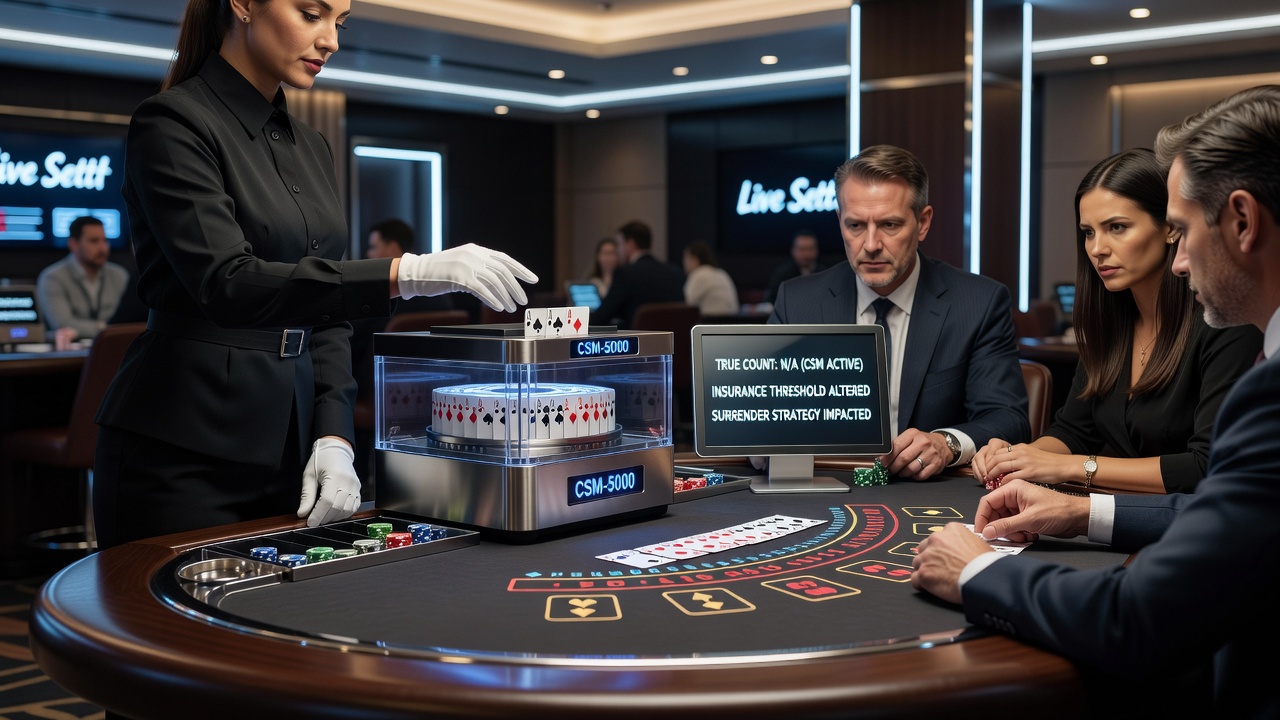
One analysis from the Australian Gambling Research Centre found that the surrender point for hard sixteen against ten can increase by approximately one full true count unit when machines cycle cards continuously. The same study noted similar but smaller movements for other surrender candidates such as hard fifteen against a dealer ten. These adjustments stem from the reduced variance in deck composition that continuous mixing produces.
Dealers and pit supervisors have observed that players attempting to apply shoe-based surrender indices encounter lower realized returns when continuous machines are present. The machines limit the duration any particular count can persist, which shortens the number of hands available to exploit the adjusted threshold.
Broader Effects on Counting Systems
Hi-Lo and similar balanced counting systems require recalibration when continuous shuffle machines enter the equation. The true count calculation itself remains mathematically identical, yet its predictive power for insurance and surrender diminishes because the underlying card distribution changes more rapidly. Reports from the Canadian Gaming Association document that penetration depth, a key variable in traditional games, loses relevance once machines handle shuffling duties.
Operators in several jurisdictions have implemented these machines to increase game speed and reduce opportunities for advantage play. Figures released in September 2026 by regional gaming authorities show continued adoption across mid-stakes tables, particularly in markets where regulatory frameworks permit automated shuffling technology.
Conclusion
Continuous shuffle machines alter the relationship between true counts and the optimal points for insurance and surrender by limiting extreme deck compositions and shortening the persistence of count signals. Research from gaming control bodies and academic centers demonstrates that thresholds for these decisions typically rise compared with static shoe games. Players and analysts who track these environments adjust their indices accordingly to maintain accurate expected value calculations in live settings where the machines operate.